To view this page in another language, please click here:


Art
Gallery
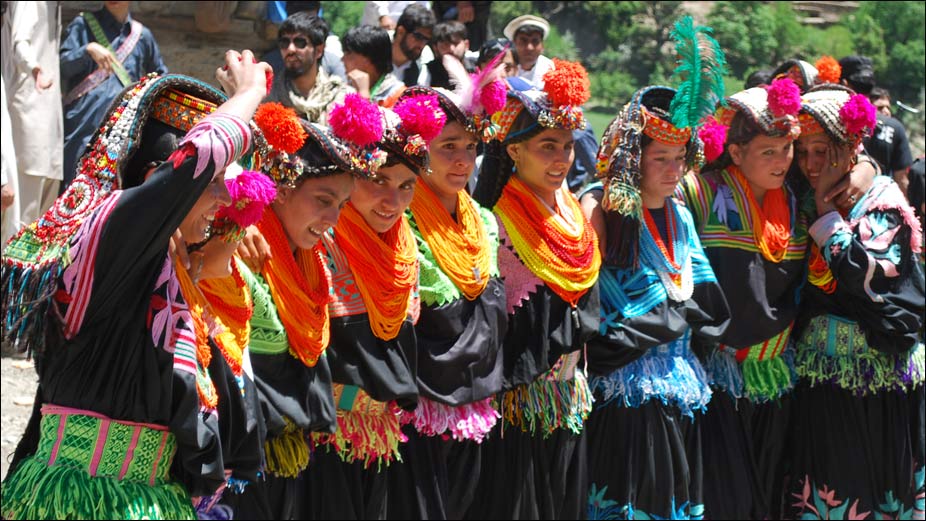
"Brargini, doy tazim"
(Brothers, he will give thanks.)
History of the Kalash
"I dedicate this page to my good friend, M. Bugi,
his family, and to the
Kalash
people ('mountain people'), located in a
beautiful valley
high up in the Himalaya Mountains."
Kalash Blog
Lakshan Bibi speaking at the
UN regarding global
warming
May 22, 2007
Articles
A Little Boy Said to His
Mother
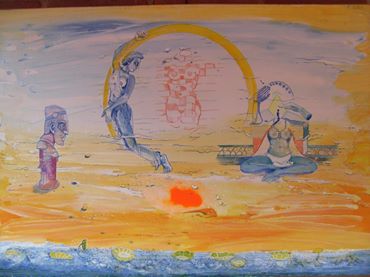
Bugi combines
tradition and surrealism
Kalasha
Peoples
Call for Cultural Survival
Two-week Kalash festival kicks off
Main Menu
Chinese
Calligraphy
by
Lee
Shouping
The
Kalash in Quarantine
Mahraka.com
A Website on the Culture,
History and Languages of Chitral.
The Kalash
or Kalasha, are an ethnic group found in the Hindu
Kush mountain range in the Chitral district of
the North-West
Frontier
Province of Pakistan. Although quite numerous
before the twentieth century, this non-Muslim group
has been partially assimilated by the larger Muslim
majority of Pakistan
and seen its numbers dwindle over the past century.
Today, sheikhs, or converts to Islam, make up more
than half of the total Kalasha-speaking population.
The culture of Kalash
people is unique and differs drastically from
the various ethnic groups surrounding them. They are
polytheists and nature plays a highly significant and
spiritual role in their daily life. As part of their
religious tradition, sacrifices are offered and
festivals held to give thanks for the abundant
resources of their three valleys. Kalash
mythology and folklore has been compared to that of
ancient Greece, but they are much closer to
Indo-Iranian (Vedic and pre-Zoroastrian) traditions.
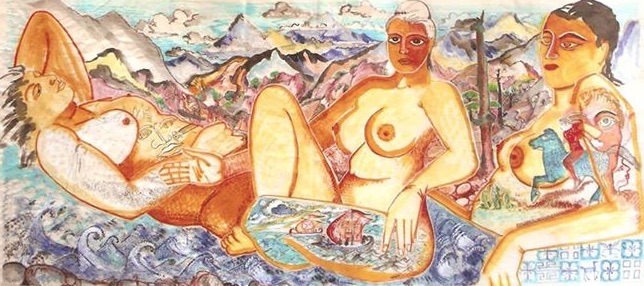
Wonderful To Pay Tributes to HISTORY, and there is No shame in admitting that Great Artists have Influenced me, Instead of Finding Easy routes for fame Fortune and Glory I LOVE my Teachers, as i call Myself a Student of History,lots of My works are There, to support one of Its Kind, he is a Master, Jamil Naqsh Was My Teacher in Pakistan, as well as Father of Danish Azar Zuby I learnt a Lot from Them,,as well as Multiple images Of Surrealism, Hieronymus Bosch the GREAT Master, and Of Course what u see here Is REMBRANDT-
Words Of Johanna from USA, half Greek Half American-(QUOTE). For several years now, i have been privileged to be a part of a movement in acknowledgment of Kalash and indigenous tribes by our dear one, MBugi....the incorporation of Mr. Wajid's choice of music enhances the beautiful/loving paintings MBugi presents to us; his love for people around the world is more than inspiring, it is uplifting! He encourages w/out his knowing....touches heart strings so deeply that one is lead to follow such a person so dedicated. MBugi's ability to coordinate and make possible to all the works of his lifetime. Most assuredly, he has and will leave such a legacy. I as well, include the children; who are our future. The children who come to us to learn with desire and he makes it possible for them to exhibit their feelings/emotions in to art in the finest ways. All who observe, come in to contact w/him are included in his tributes to his people of Pakistan. It IS humbling when after so many years he continues
INNOVATIONS OF REMBRANDT
Rembrandt Harmenszoon Van Rijn, who many consider the greatest artist of all time, learned all that was then known about oil painting while still a very young man, surpassing his teachers very early in his career, and then proceeded to add his own discoveries to the technical knowledge of his time. To this day Rembrandt’s best works remain unsurpassed, and serve as inspiration to those of us who paint. This being the case, any book on advanced techniques must address Rembrandt separately and at such length as the author's knowledge allows. What technical information Rembrandt was taught may be discerned by studying the works of his instructors, Jacob Isaacxszoon Van Swanenburch and Pieter Lastmann. Such study also immediately shows the genius of Rembrandt by the extent to which he so obviously surpassed them both, and by how early in his career he did so. Nonetheless, his training under them was an important factor in his artistic development,
Nonetheless, his training under them was an important factor in his artistic development, and should not be minimized, as both teachers seem to have possessed a working knowledge of the painting methods in use at that time. Various examples of Rembrandt's work show that he was not limited to any one technique, but employed them all, the choice depending on which approach best suited the subject in question, and for what purpose the painting was intended. His facility with all three of the aforementioned methods of painting soon led him to combine aspects of one with another, and to add innovations of his own.
*Sitarist is Nikhil Banerjee Raag Darbari *--
and I hope that you Will Write some thing please, as After the Petition is Finished i shall Continue for Promotion of Arts In Pakistan,__/\__
Vir Kashmiri ........quote,.......infatuating the lingering music in the background is gripping.....its still running.....
Vir Kashmiri ........Bugi ji you are sheer joy thank you greatly for your presence...
MBugi
it took me 40 Long Years to Compile Work as well as Collect These Images, and Syed Wajid Based in Dubai Chose and Gave structure to My Ideas, as Great Master and His association with Mughals was Attributed, Most Of the Western Press Hides his Copies for it Brings Prejudice against Him,, Copying Masters,I also Got a Cold Shoulder from Rembrandt Museum In Amsterdam---I carried On Regardless, RESULT is Here, Specially The last Letter from National College Of Arts Now we will Try to work On *FAIZ AMAN MELA* The Chitralis are still speaking today one of the oldest Indo-European languages in a relatively undiluted form. This is not surprising in view of the remoteness of their area. They are so far up in the Hindu Kush mountains that it would be almost impossible for an invader to conquer them. By far the lowest pass into Chitral is Lowari Top, which is over 10,000 feet high, too high for an invading army easily to cross. The path up the Kunar river from Jalalabad becomes so narrow below Ashret that no invading army has ever tried it. There have been several attempts to invade Chitral within relatively modern historical times. One group came across Boroghol Pass, were defeated and went back. Another group came across Urtsun Pass. The British in 1895 simultaneously came across Shandur Pass and Lowari Top in a mission to rescue a group British hostages which had been taken. They conquered the area, which is the reason why Chitral is now part of Pakistan.
The world's highest polo playground is located here. It is surrounded by some of the most spectacular mountains in the world. The history of this annual polo tournament at the Shandur Top dates back to 1936 when a British Political Agent, Major Cobb organised the first polo tournament here. Major Cobb was fond of playing polo under full moon and he developed a polo ground near Shandur that was named after him and is still known as 'Major Cobb Moony Polo Ground'. Polo fans gather at Shandur from all over the world to participate in the spectacular polo events during this tournament.
Mainland Pakistan refers
to the people of Punjab, Sindh and Peshawar. The
Kalash people and their way of life are being
destroyed by tourism
like this.
Modern progress should never be used at the expense of
any peoples culture.
to do all we can to prevent this cultural loss.
The Kalash people will be forever grateful for all of your support!
Burushaski
Song and Images of my adopted Kalash families,
from MBugi Bugi Bugiandassociates.
Thank you. I hope that you will remember The
Silk-Route is full of Poets, Stories and Songs:
Travelled from heart to heart before the actual
writing were written,
I am very proud of the area, although I am not from
there.
This is one of the best films I have seen about the
Kalash and the people of the area of Chitral, Nager,
Hunza.
In this small region more then 10 ancient Languages
are spoken and the anthropologists are puzzled.
Mr George Morgersterine from Norway wrote in 1935 that
the area has no parallel to other areas in the whole
world,
with such richness in culture and so strong in
history.
 Return to Indigenous Peoples'
Literature
Return to Indigenous Peoples'
Literature
Compiled by: Glenn
Welker
ghwelker@gmx.com
This page last updated 12/08/2019 15:45:37
This site has been accessed 10,000,000 times since February 8, 1996.